drawio-export-action is a Docker-based GitHub Action. Its src/runner.sh entrypoint used to hold everything in one file: git config --system --add safe.directory side effects, exit 1/exit 0 control flow, the action-mode and reference resolution logic, and the argument building for the underlying drawio-exporter binary.
That worked, but it made the logic almost impossible to test in isolation. The only way to exercise it was to actually run the action end-to-end: make test, which builds the Docker image and runs the tests/*.bats integration suite against it. Every edge case in the action-mode decision table (auto, reference, recent, push, pull_request, skip, none, shallow-clone detection) required a full Docker build to verify, which made iterating on a one-line logic fix painfully slow (issue #36).
Split the pure logic from the side effects#
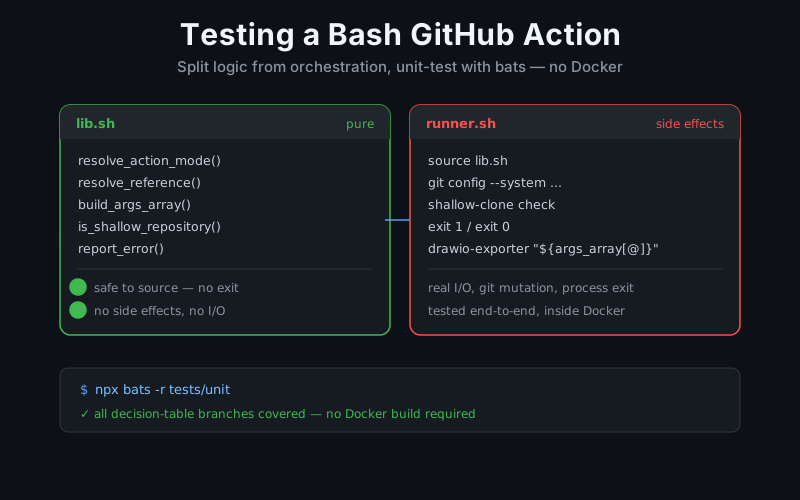
The fix was to extract everything that could be pure logic into a new src/lib.sh: resolve_action_mode, resolve_reference, build_args_array, is_shallow_repository, report_error, plus thin wrappers around the external git calls (git_branch_contains, git_merge_base_of_head) so they can be stubbed in tests.
The rule for lib.sh is strict: sourcing it must have no side effect. No exit, no git config mutation, no process invocation: only function definitions. src/runner.sh keeps everything that actually does something: it sources lib.sh, performs the real side-effecting steps (the safe.directory config, the shallow-clone check with exit 1, skip/none handling with exit 0/exit 1), and finally invokes the packaged drawio-exporter binary with the built args.
That single boundary (logic that’s safe to source versus a wrapper that does the real I/O and exits) is what makes the logic testable without Docker at all.
Reuse the test framework you already have#
The project already used bats-core for its Docker-based integration tests. Rather than reaching for shunit2 or shellspec for the new unit layer, the same framework was reused for a tests/unit/ suite that sources lib.sh directly and exercises every branch without Docker, without a real GitHub Actions context, and largely without a real git repository:
npx bats -r tests/unitWired up as make unit-test, this is now the fast, no-build path documented in CONTRIBUTING.md, sitting next to the slower make test that still builds the image and runs the pre-existing tests/*.bats integration suite. The two suites are complementary, not redundant: unit tests give fast, exhaustive coverage of the decision logic; integration tests give confidence that the packaged action still works end-to-end: Docker build, action.yml inputs mapping, and the real exporter binary included.
The catch: state leaks when you source instead of running a subshell#
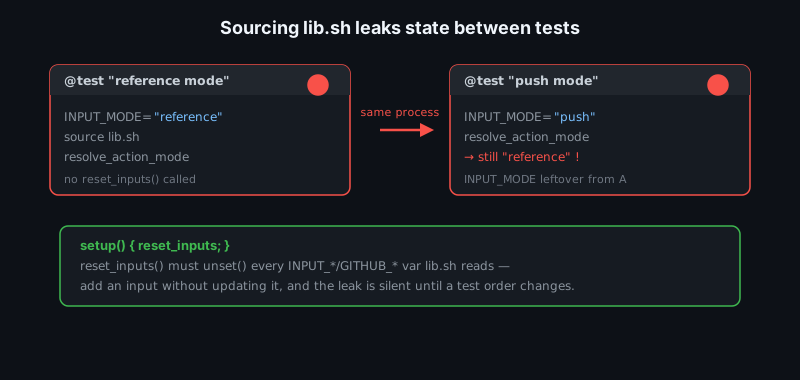
Because the unit tests source lib.sh directly into the bats test process rather than running it in a subshell, any global variable or INPUT_*/GITHUB_* env var left over from one test bleeds into the next unless it’s explicitly unset. lib.sh’s functions communicate entirely through globals: they read a long list of INPUT_*/GITHUB_* env vars and set action_mode, error_message, reference, args_array as their “return value”, so a test_helper.bash with a reset_inputs() run in setup() is required to unset every one of them before each test.
The trap is that this list has to be manually kept in sync with every input the logic reads. Add a new input to action.yml/lib.sh without a matching entry in reset_inputs, and nothing breaks immediately: it silently leaks into whichever test happens to run next, producing flaky, order-dependent failures that are hard to trace back to a missing unset.
The unit suite also isn’t wired into any CI workflow yet: only make unit-test run locally exercises it, so a regression it would catch can still slip through green CI today. Worth remembering: a fast, thorough test suite only gives real safety once it’s actually in the pipeline.
The general pattern#
None of this is specific to drawio-exporter. For any bash-based GitHub composite or Docker action:
- Split the entrypoint into a side-effect-free logic library (safe to
source, noexit, no external mutation) and a thin orchestration wrapper that does the real I/O and exit calls. The logic can then be unit-tested withbats(orshunit2/shellspec) without Docker, without a GitHub Actions context, and without a real git repository for most cases. - If you already have a test framework for integration tests, reuse it for the unit layer instead of introducing a second one. One runner, one syntax, one dependency to maintain.
- If your logic communicates through global variables instead of arguments and return values, be deliberate about resetting them between tests, and remember to actually wire the new suite into CI, or it’s just a false sense of safety.